Driving Lessons Hounslow
- The UK Driving School
- Driving Lessons Hounslow
Driving Lessons in Hounslow Fast-Track, Intensive & Automatic Courses Across Hounslow Town Centre, Lampton, Spring Grove, Heston, Cranford & North Hyde
Welcome to The UK Driving School in Hounslow. From the bustling A315 High Street and the fast-flowing Great West Road to the tree-lined avenues of Lampton, the historic Spring Grove conservation area, the aviation-themed streets of Heston, the airport-fringe lanes of Cranford, and the canal-side roads of North Hyde, our DVSA-approved local instructors will guide you to a first-time pass with patience, skill, and genuine local expertise.
Hounslow is a large suburban district in West London, approximately 10.6 miles west-southwest of Charing Cross. It grew from a coaching stop on the historic Bath Road into a major commercial and residential centre, and today sits at the crossroads of some of the busiest roads in the country—the A4, the A30, and the A315—with the M4 motorway just to the north and Heathrow Airport immediately to the west. Whether you are a complete beginner, a nervous driver wanting automatic lessons, or someone looking for an intensive course to pass quickly, we will build a personalised plan that fits your life and gets you test-ready on the roads you will drive every day.
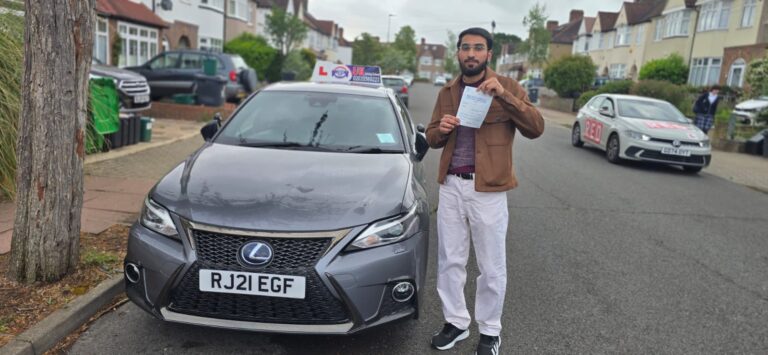
Why Learn to Drive with The UK Driving School in Hounslow?
- Exceptional Local Knowledge – Your instructor lives and teaches right here. You will master every local challenge: the A315 Staines Road and London Road, the A4 Great West Road dual carriageway, the A3005 Lampton Road, the A3063 Heston bypass, the M4 Junction 3 approach, the busy A312 The Parkway, the complex signal-controlled junctions around the Treaty Centre, and the narrow residential streets that surround Hounslow Heath.
- Manual & Automatic Lessons – Modern dual-controlled cars, with manual or automatic gearbox. Automatic is an excellent choice for handling the heavy stop-start traffic on the A4 and A315 during peak commuting hours, and the constant flow of airport-related traffic around Cranford and North Hyde.
- Fast-Track Test Booking – We find and book earlier practical test dates so you are not waiting months.
- Free Door-to-Door Pick-Up – Collected from your home, work, or station across TW3, TW4, TW5, and nearby postcodes. Your lesson time is driving time, not travel time.
- Pass Protection – Many courses include a free re-test and extra tuition, giving you complete peace of mind.
- Flexible Scheduling – Morning, afternoon, evening, and weekend lessons available, ideal for commuters, families, and students at West Thames College and Brunel University.
Your Local Driving Test Centres
Hounslow does not have its own driving test centre, but the closest DVSA facility is just over the boundary in Isleworth, and we will prepare you for its routes until they feel second nature.
Isleworth (Fleming Way) Driving Test Centre
- The Wireless Factory, 8 Fleming Way, Isleworth, TW7 6DB *The nearest and most frequently used test centre for Hounslow learners, located just 2.8 miles east of the town centre. The centre is based at the Wireless Factory on the Fleming Way industrial estate, and the DVSA operates a modular building here as a driving test centre. It is one of the busiest test centres in the area, with well over 12,000 tests conducted in recent years. The Isleworth test currently posts a pass rate of approximately 51.8%, sitting comfortably in the mid-range for London centres. After heading off from the Fleming Way estate, your test route will take place in areas such as Hounslow, Twickenham, Brentford and Isleworth itself. You can expect a mix of high-speed roads, complex junctions, and residential streets. We will rehearse every route variation until you feel completely at home on exam day.*
Tolworth Driving Test Centre
- Douglas House, 1B Douglas Road, Tolworth, KT6 7RZ *An alternative centre for learners on the southern side of Hounslow, reachable via the A3. Tolworth routes include the multi-lane Tolworth roundabout and the residential streets of Surbiton.*
We also fast-track your theory test at nearby centres such as Kingston upon Thames, Staines, or Southall.
How to Book Your First Driving Lesson in Hounslow
Contact us by phone at +44 20 3556 9223 or fill in the quick form below.
Share your postcode, availability, and driving experience (absolute beginners are very welcome).
We’ll match you with a friendly local instructor and provide a no-obligation, fixed-price quote.
Start driving on the roads you know, and get fully prepared for test day.
Manual Driving Lessons
-
6-Hour Manual Refresher Course – £225 (£75/2hr) – Perfect for returning drivers -
10-Hour Fast-Track Manual Course – £375 (£75/2hr) – Ideal for a quick start. -
20-Hour Intermediate Manual Course – £750 (£75/2hr) – Our most popular option. -
26-Hour Intermediate Manual Course – £975 (£75/2hr) Best Seller -
30-Hour Intermediate Manual Course – £1125 (£75/2hr) – For confident, test-ready drivers. -
40-Hour Beginner Manual Course – £1500 (£75/2hr) – Complete training from start to pass -
46-Hour Beginner Manual Course – £1725 (£75/2hr) – From first gear to full test readiness. -
3-Hour Manual Motorway Masterclass – £150 (£50/hr) – Conquer high-speed roads.
Automatic Driving Lessons
-
6-Hour Automatic Refresher Course – £240 (£40/hr) – Boost your confidence quickly. -
10-Hour Fast-Track Automatic Course – £400 (£40/hr) – Learn quickly and efficiently. -
20-Hour Intermediate Automatic Course – £800 (£40/hr) – Steady progress, great value. -
26-Hour Intermediate Automatic Course – £1,040 (£40/hr) – Build strong skills. -
30-Hour Intermediate Automatic Course – £1,200 (£40/hr) – Test preparation included. -
40-Hour Beginner Automatic Course – £1,600 (£40/hr) – From zero to confident driver. -
46-Hour Beginner Automatic Course – £1,840 (£40/hr) – Full package for new learners. -
3-Hour Motorway Automatic Course – £150 (£50/hr) – Master motorway driving in one session.
Start Your Driving Journey Today
-
The cost of driving lessons in London doesn’t have to be overwhelming. With UK Driving School, you get affordable, high-quality training that takes you from learner to licensed driver confidently -
Your future behind the wheel starts now. Book your package today and get ready to drive.
Areas We Cover & Key Local Facts
Our instructors are based locally, so you will never waste lesson time. We cover every street, lane, and junction in these neighbourhoods.
Hounslow Town Centre (TW3)
Hounslow town centre is the commercial and transport heart of the borough, centred on the A315 High Street, Staines Road, and London Road. The area grew around a historic coaching stop on the Bath Road and developed rapidly with the arrival of the railway and the Piccadilly line in the early 20th century. Today, the Treaty Centre shopping mall dominates the pedestrianised High Street area, and the bus station provides interchanges with bus routes to Heathrow, Kingston, Richmond, Ealing, and beyond. For learners, the town centre presents a complete driving education: the A315 is the main arterial route, while the A314 Hounslow Avenue sweeps south-west—impressively wide and straight—branching off the old Roman route. The signal-controlled junctions, one-way systems, and high pedestrian volumes demand excellent observation and lane discipline. The town centre generally features a poor environment for pedestrians, which is detrimental to accessibility, and the borough has plans to improve pedestrian priority and station connections. Hounslow Central and Hounslow East tube stations sit on the Piccadilly line, linking the area to Heathrow and central London.
Lampton (TW3)
Lampton is a small area of Hounslow located on the Great West Road between Hounslow town centre and Heston, with its name deriving from the Old English for “lamb farm.” Lampton was traditionally the property of the Bulstrodes, lords of the manor of Hounslow, from the 18th century onwards. Their plans to create grand housing along Lampton Road in 1881 were unsuccessful, and the area remained a small, primarily agricultural hamlet until the late 19th century. It became built-up as a result of the extension of what is now the Piccadilly line to Hounslow. For learners, Lampton presents a distinct set of local driving features. The area gives its name to Lampton School, Lampton Road, and Lampton Park—once the grounds of Lampton House. The A3005 Lampton Road is a key route running through the area, and the section approaching the A4 Great West Road is a fast, busier road requiring confident merging. The residential streets around Lampton Park offer a quieter environment for early lessons and manoeuvre practice, while the proximity to the Hounslow Civic Centre (currently subject to planning notices for highway diversion) means you will experience real-world navigating around changing road layouts. Hounslow Central tube station is 0.4 miles away, providing a convenient meeting point.
Spring Grove (TW3, TW7)
Spring Grove is the north-western district of the town of Isleworth within the London Borough of Hounslow. In general terms, it lies east of Lampton, north of the district of Woodlands, west of the Barnes-to-Feltham railway loop line, and south of Osterley. Spring water that rose in the area in the 18th century was employed for agricultural and horticultural purposes. The area is centred around Spring Grove House, the former home of botanist and explorer Sir Joseph Banks, which is now part of West Thames College. In the 1850s–1860s, the vision for the area was of a grand Victorian suburb with Italian-style villas designed by architect John Taylor. Other architectural features include a former college by John Norton & P. E. Massey and a variety of Arts and Crafts semi-detached houses. For learners, Spring Grove Road is the main thoroughfare, hosting local shops and services and lying at an average height of 24.7 metres above sea level. The road patterns were made to form around Spring Grove House and its lodges, with roads including Clifton Road, Villiers Road, and Pembroke Place laid out by 1865 and forming part of one of the historic areas of Spring Grove. The Great West Road was built in 1925, and as industries developed, traffic increased in the Isleworth area—the road also severed Thornbury Road and St Mary’s Crescent, dividing Osterley and Spring Grove. Isleworth Crown Court is situated in the Spring Grove area, housed in a building that was previously a hostel for paraplegics and extended in the 1990s. Isleworth railway station was formerly called “Spring Grove & Isleworth,” reflecting the area’s historic identity.
Heston (TW5)
Heston is a suburban area in the London Borough of Hounslow, 10.8 miles west south-west of Charing Cross, with the residential settlement covering a slightly smaller area than its predecessor farming village. The village has been settled since Saxon times and was first recorded as having a priest in the 7th century, though the present Anglican parish church of St Leonard dates to the 14th century. Before 1229, Heston was part of the parish of Gistleworth (Isleworth) before being taken by Henry III and later granted to the Earl of Cornwall. The separation from Isleworth in the 14th century gave locals a sense of independence from the inhabitants and feudal lords of Isleworth, with whom they frequently quarrelled—the practice of “beating the bounds” was practised annually. For learners, Heston offers a fascinating mix of historic village character and modern suburban driving. The area is bounded by the A4 Great West Road to the south, which leads directly to Heathrow Airport and beyond, and the M4 motorway is about 0.5 miles north, with its closest exit at Junction 3. Three minor roads converge on Heston from the A315: the A3063, A3005, and B363—a single road that re-divides just north into Norwood Green. One particularly charming local detail is that many roads in the area have aviation-related names, such as Alcock Road (named after Alcock and Brown, who made the first non-stop transatlantic flight), reflecting Heston Aerodrome’s important role in early British aviation. Heston is well-served by bus routes providing easy access to nearby Hounslow, Heathrow Airport, and central London, and dedicated cycle lanes and routes make it a balanced environment for hazard perception.
Cranford (TW4, TW5)
Cranford is a suburban area straddling the London Boroughs of Hillingdon and Hounslow, located 12.5 miles west of Charing Cross and immediately east of Heathrow Airport, from which it is separated by the River Crane. Before the Norman Conquest, the village was a small Saxon settlement in all senses completely surrounded by its open fields abutting the north of Hounslow Heath, and it fell within the Elthorne Hundred for troop-mustering and taxation purposes. The Cranford Bridge on Bath Road was rebuilt in 1776 and then widened and strengthened in 1930. For learners, Cranford is defined by the A4 Bath Road running through its centre and the presence of Heathrow Airport immediately to the south, which results in a mix of residential streets, airport-related commercial uses, and constant traffic flow from those commuting to and from the airport. The conservation area itself comprises the historic Cranford Village, bounded by the Bath Road to the south, the River Crane to the west, and the Parkway to the northeast. St Dunstan’s Church, with its stable block, is a notable landmark. Cranford Lane has been one of the major traffic problems in the area, with volumes varying as displaced traffic shifts in response to one-way schemes. The proximity to Heathrow means you will gain experience driving under low-flying aircraft and alongside heavy goods vehicles—a uniquely valuable real-world skill. Cranford Park, with its open greenspace, adds a rural dimension to the area’s roads.
North Hyde (TW5)
North Hyde is a suburban development situated between the towns of Heston and Southall, under the administrative control of the London Borough of Hounslow. It is bordered to the north by the Grand Union Canal mainline and to the south by the M4 motorway, a geographical containment that shapes the driving environment significantly. Historically, before the 18th century, North Hyde formed part of the infamous Hounslow Heath—a vast, lawless tract of land notorious for highwaymen. During the Napoleonic Wars, the Board of Ordnance established a gunpowder depot at North Hyde alongside the canal, with 47 acres compulsorily purchased in 1813. Three magazines, each holding 6,800 barrels of powder, were built along with barracks for three officers and fifty soldiers, and by 1830 some 42,000 barrels of gunpowder were being stored there before the depot closed. For learners today, North Hyde offers a distinctive mix of canal-side lanes and motorway-adjacent roads. North Hyde Lane runs at an average height of 32.3 metres above sea level, with elevations ranging from 28.2 m to 37.9 m. The area is characterised by large, semi-detached suburban properties, and the Convent Way estate is a notable feature offering both high-rise and low-rise housing options. The Airlinks golf course sits within the area, and the canal towpath attracts cyclists and walkers, building your hazard perception near waterways. The proximity to the M4 (though there is no direct junction within North Hyde itself) and the major transport corridor of the Grand Union Canal means you will encounter varied traffic conditions—from quiet residential streets to the fast feeder roads that connect to the motorway network.
Frequently Asked Questions
Do you cover Hounslow town centre, Lampton, Spring Grove, Heston, Cranford, and North Hyde?
Yes, completely. We provide driving lessons across all these neighbourhoods with free home or station pick-up. Our instructors live locally and know every lane, junction, and test route in the area
Which driving test centre will I use if I live in Hounslow?
Most learners in Hounslow take their test at Isleworth (Fleming Way) Driving Test Centre (TW7 6DB), which is just 2.8 miles from the town centre. It is one of the busiest centres in the area, with a pass rate of approximately 51.8%. We also prepare learners for Tolworth if that offers a faster or more convenient test date.
Do you offer automatic driving lessons in Hounslow?
Absolutely. We have dedicated automatic instructors and cars in the area. Automatic lessons are very popular for handling the A4 Great West Road, the A315 through the town centre, the airport traffic around Cranford, and the stop-start congestion near the M4 without the distraction of clutch control.
How long does it take to pass with an intensive course in Hounslow?
Complete beginners can be test-ready in around 4–6 weeks with a full intensive course (40–48 hours). If you already have some driving experience, we can often get you to test standard within 1–2 weeks and fast-track your test booking.
Are your instructors fully qualified?
Yes. Every instructor at The UK Driving School is DVSA-approved, fully insured, and highly experienced on local test routes, including the Isleworth routes that frequently take in Hounslow, Twickenham, Brentford, and Isleworth.
Can I get picked up from Hounslow Central, Hounslow East, or Hounslow West tube stations?
Of course. We pick up from home, work, the station, or any convenient location across Addlestone, New Haw, Woodham, Row Town, Sayes Court, and Hamm Moor. Just tell us what suits you best.
What are the key driving challenges in Hounslow and the surrounding areas?
Key challenges include the A4 Great West Road dual carriageway, the A315 Staines Road and London Road through the town centre, the one-way systems and signal-controlled junctions near the Treaty Centre, the A3005 Lampton Road, the three-road convergence at Heston (A3063, A3005, B363), the airport traffic around Cranford, the M4-adjacent roads in North Hyde, and the constant presence of buses, cyclists, and pedestrians throughout this major West London hub.
What happens if I do not pass first time?
Many of our course packages include Pass Protection, giving you a free re-test and extra tuition to strengthen any weak areas. We will support you all the way until you pass.
